Why does requirements traceability matter in modern engineering projects?
In today’s increasingly complex engineering environments, managing requirements effectively is no longer optional – it is critical to project success. Whether you are developing safety-critical systems, managing compliance-heavy industries, or coordinating large multidisciplinary teams, maintaining clear visibility from requirement to delivery is key.
One of the most effective tools for achieving this clarity is the requirements traceability matrix (RTM).
What Is a Requirements Traceability Matrix?
A requirements traceability matrix is a structured document that maps and tracks requirements throughout the entire project lifecycle. It ensures that every requirement is linked to its corresponding design elements, verification activities, and final deliverables.
Simply put, it answers three essential questions:
- Are all requirements being addressed?
- Where is each requirement implemented?
- How do we verify that it has been fulfilled?
By maintaining traceability, organizations reduce the risk of missed requirements, uncontrolled scope changes, and costly rework.
For industries such as aerospace, automotive, rail, and defense – where compliance and validation are mandatory – traceability is not just a best practice; it is often a regulatory expectation.
Why Traceability Matters More Than Ever
Engineering teams today face several challenges:
- Growing system complexity
- Distributed teams
- Increasing regulatory pressure
- Faster development cycles
Without structured traceability, even small requirement changes can create ripple effects across the entire system.
By integrating requirements management directly into the engineering ecosystem, teams gain real-time visibility and automated traceability – eliminating the fragility of spreadsheet-based approaches.
Requirement Traceability Matrix Format: Moving Beyond Spreadsheets
Traditionally, the requirement traceability matrix format has been associated with spreadsheets. While familiar, this approach introduces several risks:
- Manual updates lead to errors
- Version control becomes difficult
- Collaboration is limited
- Impact analysis is slow
Modern engineering demands a more dynamic format – one that connects requirements directly to models, risks, tests, and validation artifacts.
With SES Engineering Studio, traceability becomes a living data structure rather than a static table. Relationships are automatically maintained, allowing teams to perform instant impact analysis whenever a requirement changes.
The result? Greater confidence, faster decision-making, and improved project outcomes.
Requirements Traceability Matrix Sample: A Practical Example
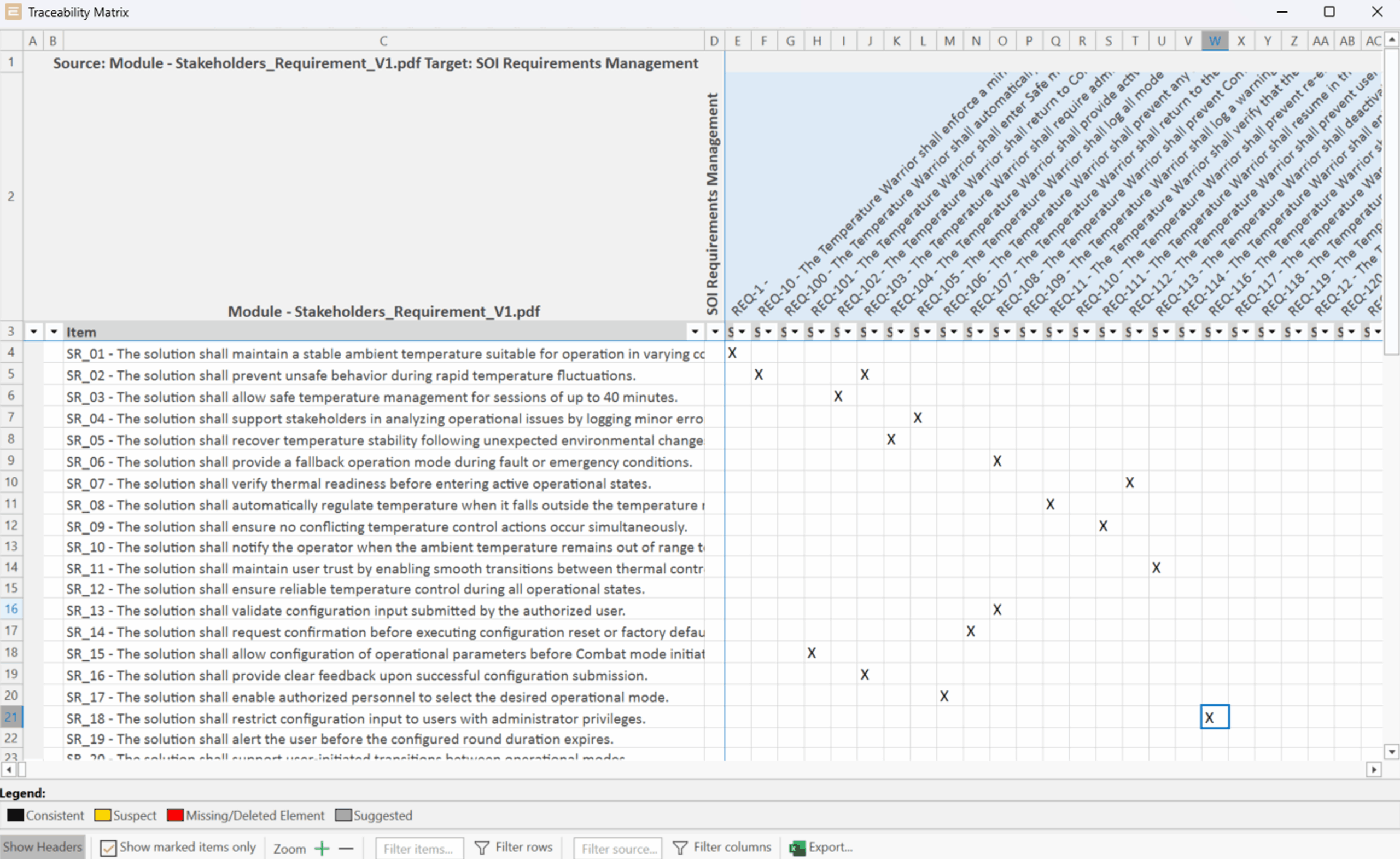
This simplified requirements traceability matrix sample illustrates how traceability provides immediate insight into implementation and validation status.
Now imagine this level of clarity scaled across thousands of requirements – and automatically updated. That is the advantage of adopting a digital engineering platform.
Turning Traceability Into a Strategic Advantage
When implemented effectively, a requirements traceability matrix delivers far more than compliance support. It becomes a strategic asset that enables organizations to:
- Improve requirement quality
- Reduce development risk
- Accelerate verification
- Strengthen cross-team collaboration
- Increase confidence during audits
Most importantly, it helps ensure that the final product truly reflects stakeholder intent.
Related Links